
How India’s Inflation and Global Rate Outlook Can Change a DCF Valuation in 2026
If your last valuation was in August, it would have been reasonable at that point however there might be some issues with using this if your deal closes in December. India has seen a 50bps increase in the 10 year G-Sec yields. The RBI has increased the repo rate for the first time in over 3 years. In addition, we have seen October retail inflation of over 6%. All of these factors play into your DCF valuation. This is what investors, auditors and regulators rely on when raising capital, issuing ESOPs or bringing in a foreign investor.
Where India’s Inflation and Interest Rates Stand in Mid-November 2026
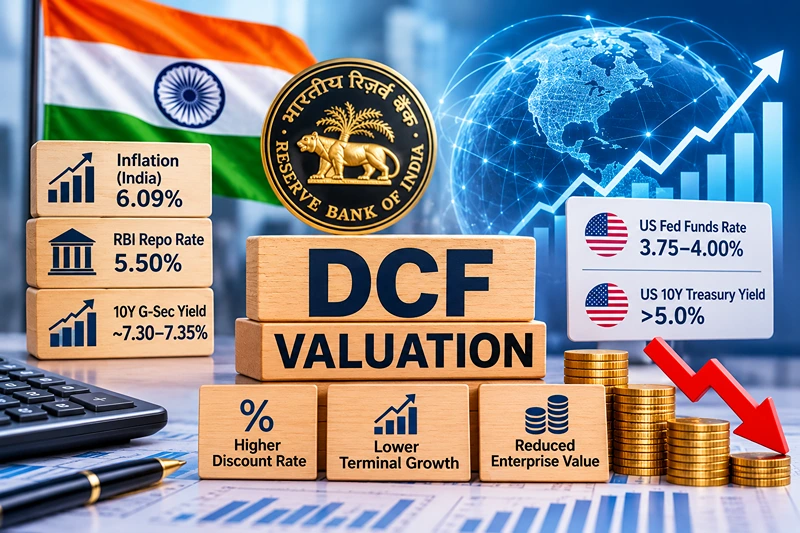
- CPI inflation: 6.09% in October 2026, just above the RBI’s 6% upper tolerance limit.
- RBI repo rate: 5.50% after a 25 bps hike on October 7, the first increase in over three years. The next meeting is on December 4.
- India 10-year G-Sec yield: about 7.30% to 7.35%, up 50 to 55 bps from roughly 6.80% in August.
- US Fed funds rate: 3.75% to 4.00%, with another hike possible in December.
- US 10-year Treasury yield: above 5.0%.
The Fed shows no hurry to ease, so global borrowing costs stay high. Treat these figures as a mid-November snapshot. A formal report must use the market rates on your own valuation date.
Why a Small Rate Change Moves a DCF So Much
A DCF model will forecast your free cash flows for a period of usually five years. These are then discounted back to today at a risk-adjusted rate, usually the Weighted Average Cost of Capital (WACC). A terminal value is then added to account for any earnings from the company beyond your forecast period. The majority of the enterprise value for most high-growth and mid-market companies comes from here. This is calculated by taking the cash flow and dividing it by the difference between the discount rate and the long-term growth rate. If this difference is only 7 points, increasing the discount rate by 1 point can have quite an impact on the value.
What to Update in Your DCF
Discount rate: risk-free rate, equity, and debt
The basic calculation is the risk-free rate (in India, usually the 10-year G-Sec yield at the time of valuation) plus beta times the equity risk premium, plus any company-specific or size premiums. If the G-Sec yield has increased by, say, 50 bps, then your cost of equity will increase. Your cost of debt will also increase if your loans are floating with the repo rate. WACC will increase, and therefore, value will decrease. Make sure you give your valuer your most recent sanction letters and debt profile, as your loan terms from last year will reflect lower borrowing costs than today’s rates.
Cash flows: let inflation in, but only once
Inflation impacts the cost of raw materials, salaries, working capital, and capex. The ability to pass these on will reduce as demand falls, so last year’s margins will likely be overstated. Ensure your cash flows are consistent with the discount rate. As the discount rate is higher today, it already reflects inflation expectations, so ensure your projections are in nominal terms. If you don’t adjust revenue, you will end up penalizing the valuation twice. For all major costs, note how much can be passed on and how long repricing will take. The timeframe is as important as the percentage of costs that can be passed on.
Terminal growth: anchor it to the long run
Terminal growth rates should be based on the long-term nominal growth of the economy and your sector, rather than a single month’s CPI. While inflation went above 6% in October, the RBI is forecasting an average inflation rate of 5.2% for FY27, which is easing toward its 4% target. Therefore, a terminal growth rate of 6% can seem appealing on paper, but it rarely holds up against auditors and investors. You should ensure your rate is justified and check the exit multiple it implies. Compare this to the multiples of listed peers and recent deals. If your multiple looks rich, your growth rate should be questioned first.
Global rates and currency
Given that US Treasuries are trading at over 5%, global investors have become very selective about emerging markets. With the India–US 10-year yield differential currently around 2.15 to 2.20 percentage points and the INR trading between ₹93.50 and ₹94 per dollar, the effective cost of capital for foreign investors has increased. In terms of FEMA and FDI valuation, it is standard practice to value new share issues to non-residents using a DCF method. Do not use a dollar rate to discount INR cash flows, or vice versa. Ensure your valuer updates the peer group, as both peer multiples and betas have changed.
A Worked Example: What a 100 bps Rise Does to Value
Take a company generating ₹10 crore of free cash flow next year, growing 10% annually for five years before settling into steady perpetual growth:
| Scenario | WACC | Terminal growth | Enterprise value (₹ crore) |
| A. Earlier (mid-year) assumptions | 12.0% | 5.0% | 167.7 |
| B. Discount rate up 100 bps | 13.0% | 5.0% | 146.3 (about 13% lower) |
| C. B, plus lower terminal growth | 13.0% | 4.5% | 139.7 (about 17% lower) |
| D. Discount rate up 150 bps, lower growth | 13.5% | 4.5% | 131.7 (about 21% lower) |
Everything else remains constant apart from the rates and long-term growth figures. Scenario A has a large portion of its value coming from the terminal value (74%), which is why a 1% increase in rates has such a big impact. This is why you should always ask your valuer for a sensitivity table. Having a valuation range across different WACC and terminal growth combinations will make your numbers easier to justify to investors.
What to Share With Your Valuer: A Quick Checklist
• Financials & projections: Do you have your latest audited or provisional statements, along with a 3-to-5-year forecast and clear assumptions?
• Debt profile: What are your current debts, including active loans, fixed or floating interest rates, and repayment schedules?
• Pricing power: How much input cost inflation have you successfully passed on to customers over the past 12 months?
• Reinvestment needs: What are your upcoming capex and working capital requirements?
• Transaction context: What is the purpose of the valuation (fundraising, FEMA/FDI compliance, ESOPs, or M&A), and what is your official valuation date?
• Cross-border details: Are any non-resident investors involved, and what is the transaction currency?
Working With ValuGenius
ValuGenius works with SMEs, startups, and growing enterprises across India. Whether you need a DCF for fundraising, a FEMA valuation (Foreign Exchange Management Act), an ESOP valuation to set a fair strike price, or M&A support, we follow the same approach: a number you can defend, a clear methodology, and every assumption explained line by line.