Startup Valuation Before Fundraising: 10 Factors Investors Examine
Investors don’t just look at a startup’s product and pitch before deciding it’s worth. They also consider several other aspects including whether the revenue quality is good or not, if the startup is efficiently growing, the way it uses its cash, its market potential, if the team is capable enough or not, whether the company is positioned in such a way that it is able to compete effectively, and the company ownership structure.
Knowing these is going to help founders to recognize their limitations soon enough, to get ready their pitching materials well so that they will be able to present a good story during the raising rounds, and to be confident while answering the due diligence interview questions.
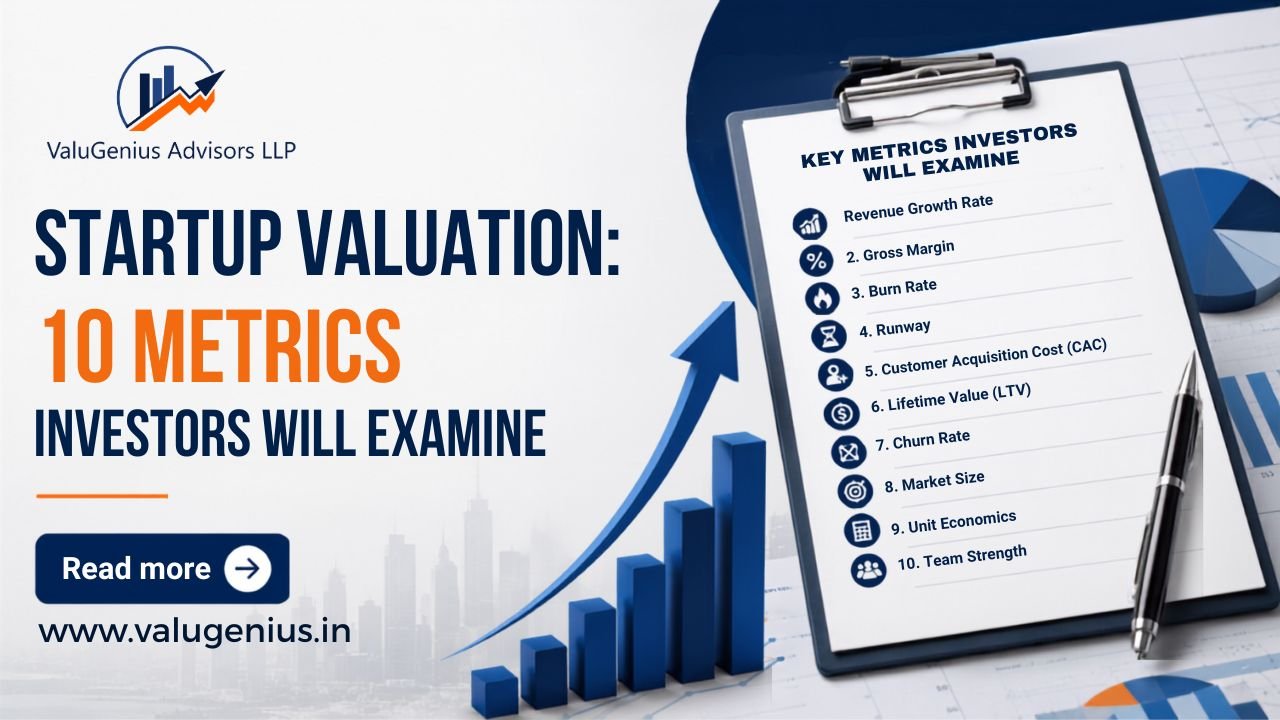
There are ten financial, operating, and strategic elements that the investors most commonly look at before determining the valuation of a startup, which this article has listed and explained as to what they signify.
1. Revenue and Revenue Growth Rate
Cash flow is frequently one of the first indicators that investors check out since it reveals an idea of market adoption and expansion. They will also want to see how fast you’ve grown your revenue.
Investors also examine the characteristics of your revenues to a great extent. Do you have a steady source of recurring revenue or have your revenues come from one-time sales? Are your clients limited to three big ones or are they a crowd of small ones?
You can imagine that depending on such factors, investors may interpret your figures quite differently.
2. Gross Margin
Revenue only provides a partial picture. Gross margins indicate how much of the revenue continues after the direct costs like hosting, manufacturing, payment processing, delivery, or customer support are subtracted. Other kinds of operating expenses not considered here are general administration, product development, and office costs.
While having a relatively low margin may not automatically invalidate the value offering itself, one should realistically address how the problem is going to be solved as the business grows. The statement “It’ll get better later” without a concrete planning strategy does not look appealing.
3. Customer Acquisition Cost (CAC)
Customer acquisition cost (CAC) tells you the amount that your company invests on average, to get a new paying customer. For example, you only need to add the expenses of marketing campaign or the commission given to a salesperson who gets you a new customer, divide it by the number of the new customers that came out of it. Founders should explain which costs and which groups of customers were taken into account.
The actual number is not the point, but how that number is moving over time is very revealing. When you’re increasing your ad budget, is your CAC rising gradually, or you’re discovering ways to scale more cheaply?
Investors know how easy it is to waste money on chasing customers that only give you little revenue, even nothing; they’ll be very keen to ask you not to burn money like that again.

4. Lifetime Value (LTV) and the LTV:CAC Ratio
It is common to see an LTV:CAC ratio of 3:1 as a rough idea, but it’s important to realize that such a benchmark isn’t necessarily suitable in every instance. When investors evaluate an LTV, they generally consider the different assumptions that can affect it, such as gross margin, customer retention and churn rate, revenue from upselling and cross-selling, and the period needed to recover CAC.
If you’re not yet monetized, or it’s far too early to calculate a reliable lifetime value of a customer for your startup, acknowledge this. Instead of picking a number that won’t survive scrutiny in a due diligence process, show what early signs you have of customer loyalty, engagement, conversions, or customer interviews that give you good insights.
5. Burn Rate and Runway
This question comes up in almost every meeting: “How much runway do you have left?” Investors want to know how much cash the company is using each month and how many months it can operate before running out of cash. The answer indicates both the urgency of the round and the company’s financial discipline.
A short runway with no clear plan raises concerns about urgency and financing risk.
A long runway with slow progress raises questions about execution speed and capital efficiency.
Founders should distinguish between gross burn and net burn. Gross burn is total monthly cash operating expenditure, while net burn is the monthly cash outflow after revenue is included. Runway is generally estimated by dividing available cash by net burn, although investors may also assess a downside scenario. Showing that you understand where you sit on this spectrum matters as much as the number itself.
6. Market Size (TAM, SAM, SOM)
Most fundraising decks include a market-size slide, but investors usually test the assumptions behind it.
Experienced investors have seen many inflated market-size slides and can quickly identify when the underlying assumptions are weak.
7. Founder and Team Strength
Investors initially bet on both the team and the product equally. They will consider your background, check the team dynamics, and finally evaluate if the team is made up of the right people, specifically in the core areas such as product development, technology, and sales.
Having a weakness in the team won’t disqualify you by default. It’s more about being aware of the deficiencies and showing a willingness and strategy to cover them.
8. Traction and User Growth
Traction is evidence that customers or users want what you’ve built. The relevant indicators depend on the business model. A SaaS company may emphasize MRR, ARR, churn, and retention. A consumer brand may focus on repeat purchases and contribution margin. A marketplace may report GMV, take rate, liquidity, and repeat transactions.
Investors are usually looking for a pattern that holds over several months, not one unusually strong week that happens to support the pitch.
9. Competitive Moat and Differentiation
Your answer needs to go beyond “we move faster” or “we care more about the customer.” Investors may look for proprietary technology or data that is difficult to replicate, network effects that strengthen as more people join, or distribution and partnerships that took years to build.
- Proprietary technology or data that’s genuinely hard to replicate
- Network effects that get stronger as more people join
- Distribution or partnerships that took years to build
Even one solid answer here goes a long way toward justifying a stronger valuation.
10. Cap Table and Prior Valuation History
Investors are the ones who would want to know the shareholders of the company who own a slice of it and under what conditions. Their analysis can include founder dilution, ESOP (Employee Stock Option Plan) distribution, SAFEs or convertible notes, liquidation preferences, investor rights, equity commitments that are not yet fulfilled, and terms associated with earlier rounds.
Also, an ESOP valuation that is justified is essential if ESOPs are included in the share pool, since issuing of options without the fair-value support can cause some issues in due diligence.

A founder’s pre-fundraising checklist
Before approaching investors, prepare a consistent view of monthly revenue and growth, gross and net burn, runway, CAC, LTV assumptions, retention or repeat-purchase data, market-size calculations, cap-table records, and any required valuation or compliance documents.
Putting It All Together
None of these ten factors determines valuation on its own. Investors weigh them together, alongside the company’s stage, sector, business model, and recent market comparables. A pre-revenue deep-tech startup and a fast-growing D2C brand will be assessed using very different evidence.
What helps is entering the conversation knowing where the company stands on each point. The numbers do not need to be perfect, but the assumptions should be clear, consistent, and defensible.
ValuGenius is a Mumbai-based CA firm helping founders and growing businesses prepare for fundraising and strategic transactions. Its services include business valuation, ESOP valuation, corporate valuation, and FEMA-related valuation advisory. By reviewing the company’s financials, cap table, assumptions, and transaction structure in advance, founders can enter investor discussions better prepared.
If you are preparing for a fundraising round, speak with the ValuGenius team to review your valuation readiness and identify potential diligence issues before investor discussions begin.